
Health System Builds 320-Member Float Pool in 6 Months

Mercy Regional’s CFO was under pressure to reduce agency staffing costs by 30% within the fiscal year or face elimination of the internal float pool.
Business Challenges
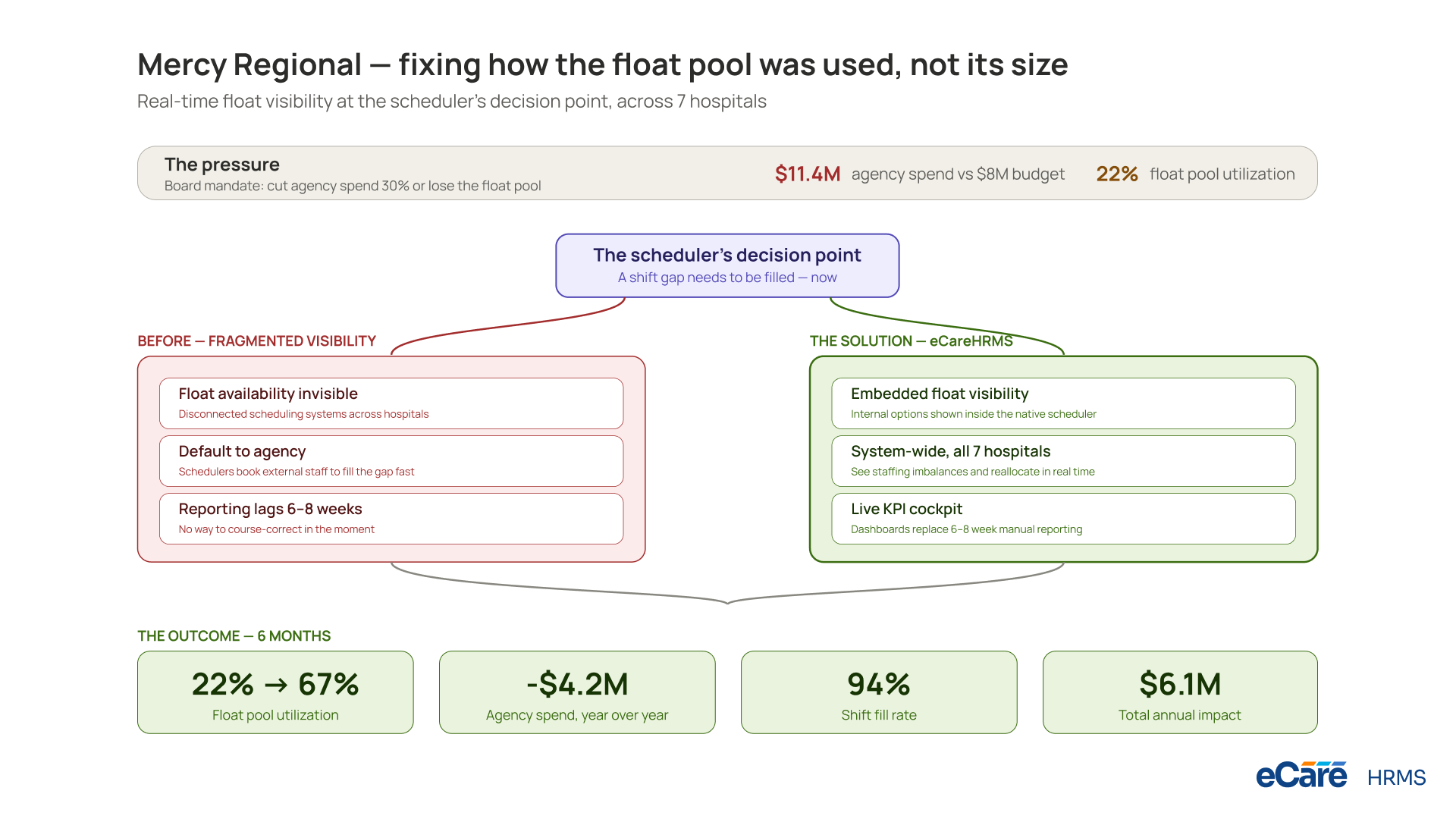
Mercy Regional Health’s CFO, Dean Holcroft, had been tracking agency staffing as the system’s most critical cost pressure for two years. Across the 7-hospital network, annual agency spending had reached $11.4M against an $8M budget, creating sustained margin pressure and repeated board scrutiny.
By Q2 2025, the board finance committee escalated expectations, requiring a 30% reduction in agency staffing spend by year-end. Failure to meet the target would result in structural cuts, including the potential elimination of the internal float pool.
Dean’s assessment differed from the board’s framing. The float pool was not underperforming in concept but in execution. Utilization remained low at 22% because staffing visibility across units was fragmented. Unit schedulers frequently defaulted to external agency staffing without real-time awareness of internal float availability.
Additional constraints included disconnected scheduling systems across hospitals, leading to inefficient staff redistribution and increased reliance on overtime. Workforce reporting was delayed by several weeks, limiting operational responsiveness.
- Annual agency spend at $11.4M against an $8M budget, prompting mandated cost reduction targets.
- Float pool utilization at 22% due to lack of real-time visibility at unit level.
- Decentralized scheduling limited cross-unit staffing optimization across hospitals.
- Increased overtime driven by last-minute shift gaps and delayed staffing decisions.
- Workforce reporting lagged by 6–8 weeks, limiting operational decision-making.
Solution
The CNO, Talia Rosenberg, led the procurement with a focus on operational usability for frontline scheduling teams. The primary requirement was real-time visibility into float pool availability directly within existing scheduling workflows, without requiring separate systems or additional user steps.
eCareHRMS was selected after demonstrating embedded float pool visibility within the scheduler’s native workflow interface. This allowed schedulers to view internal staffing options at the point of decision-making, rather than relying on external reports or dashboards.
The platform also enabled system-wide visibility across all seven hospitals, allowing schedulers to identify staffing imbalances in real time and allocate resources more effectively across units.
Value Delivered
Within six months, the system achieved significant reductions in agency staffing and improved internal workforce utilization.
- Float pool utilization increased from 22% to 67% within 6 months.
- Agency staffing spend reduced by $4.2M year-over-year (38% below baseline run-rate).
- Forced overtime hours decreased by 38% due to improved proactive coverage.
- Real-time float pool visibility adopted system-wide within the first month of rollout.
- Workforce KPI reporting transitioned to live dashboards, replacing manual reporting cycles.
Solution Provided
The deployment was executed across 16 weeks in phases aligned with hospital complexity and scheduling workflows.
Weeks 1–3: The Unit Scheduler Conversation Tour
Workshops were conducted with 38 unit schedulers across all seven hospitals to map existing staffing workflows, identify decision points, and define operational requirements for float pool visibility.
Weeks 4–7: Configuration Build and Two-Hospital Pilot
The platform was configured and deployed across two hospitals with different operational scales to validate workflow adaptability and performance consistency.
Weeks 8–11: Hospitals 3–5
Three mid-size hospitals were onboarded, leveraging insights from the pilot phase. Adoption timelines shortened as workflows aligned closely with existing scheduling practices.
Weeks 12–14: Hospitals 6–7
The remaining two hospitals were brought live, with focus on standardization and training for new scheduling staff.
Weeks 14–16: Workforce KPI Cockpit and Board Reporting
A centralized workforce analytics dashboard was implemented, providing real-time visibility into staffing, agency utilization, overtime, and float pool movement across the system.
Business Value
The CFO presented results to the board in Q4 2025, emphasizing both financial outcomes and structural workforce improvements.
What changed at the system level
The float pool was repositioned from a cost center to a strategic workforce asset. Plans to eliminate the float pool were discontinued, and the system began modest expansion of float staffing capacity based on improved utilization visibility.
The financial picture
Agency staffing costs decreased by $4.2M annually, with additional savings from reduced overtime and lower turnover pressure. Total annual financial impact was approximately $6.1M against a $580K implementation cost, with rapid payback achieved within weeks.
What changed about workforce as a discipline
Workforce planning shifted from periodic reporting to real-time operational management. Unit schedulers gained system-wide visibility, and workforce data became integrated into ongoing operational decision-making rather than retrospective reporting.
The CFO’s summary
“The decision was whether to cut the float pool or fix how it was used. Real-time visibility changed the outcome. The reduction in agency spend came from better utilization, not reduction in capacity.”