Regional Hospital Cuts Nurse Turnover by 28% with Schedule Redesign

A union organizing drive pushed Northgate Regional Hospital to address RN retention after turnover data became a central concern.
Business Challenges
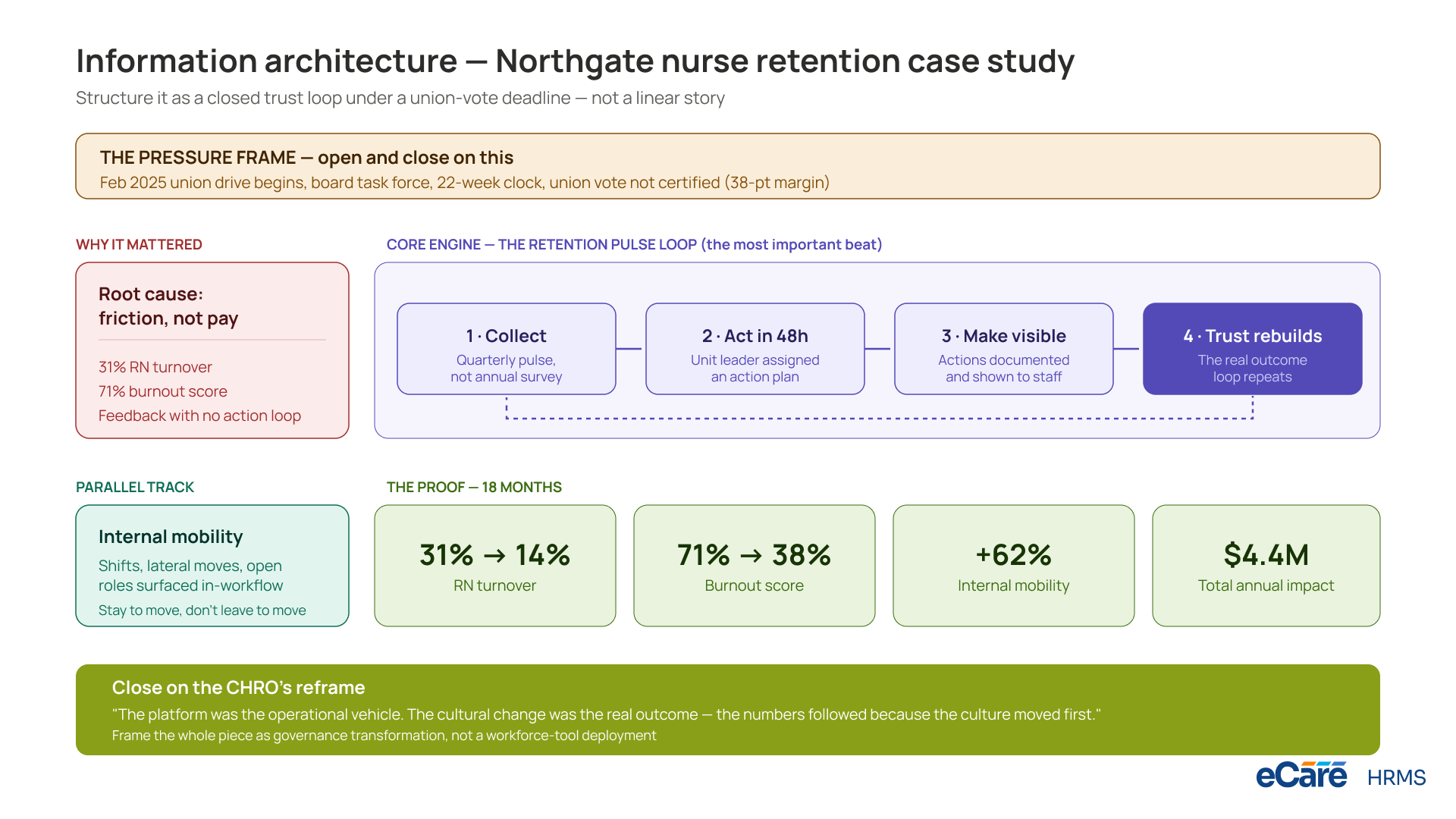
In February 2025, a union organizing effort began at Northgate Regional Hospital, quickly gaining traction among nursing staff. By April, a formal campaign was underway. The union’s messaging consistently referenced operational conditions, particularly a 31% RN turnover rate and limited internal mobility.
For leadership, the campaign reframed retention from an HR metric into a governance risk. The board immediately formed a Retention Task Force with authority to act within a compressed timeline.
The underlying issue, as identified by the CHRO Bernard Tanaka, was not market-driven scarcity. It was operational friction.
Nurses were leaving due to workload structure, not compensation. Key drivers included documentation burden, rigid scheduling, lack of internal mobility, and absence of visible action on prior feedback.
- RN turnover at 31%, with ~$58,400 replacement cost per nurse
- Internal mobility constraints requiring nurses to leave for better shifts or units
- Burnout score at 71% across units
- Annual engagement surveys with no visible action loop
- Exit interviews not structured into operational decision-making
Solution
Northgate deployed eCareHRMS as a closed-loop retention and workforce engagement platform, led jointly by the CHRO and a nursing-led task force.
The core redesign replaced annual engagement surveys with quarterly “retention pulse” cycles. These were short, structured check-ins focused on identifying real-time workflow friction.
Each pulse cycle produced a structured response loop:
- Feedback categorized at unit level
- Action plans assigned to unit leaders within 48 hours
- Actions documented and visible to staff
This closed-loop system ensured that feedback was not only collected but visibly acted upon, rebuilding trust between staff and leadership.
A second capability focused on internal mobility. The platform exposed shift opportunities, lateral moves, and open roles directly within nursing workflows, removing the need to exit the organization to find schedule flexibility.
Together, these addressed the two core retention drivers: responsiveness and mobility.
Value Delivered
Over 18 months, Northgate saw sustained workforce improvement across all units.
- RN turnover reduced from 31% to 14%
- $3.0M annual savings from reduced replacement costs
- Additional $1.4M savings from reduced agency staffing
- Burnout score reduced from 71% to 38%
- Internal mobility increased by 62%
- Engagement shifted from annual surveys to quarterly closed-loop cycles
The most significant change was structural: staffing predictability improved, reducing reactive scheduling pressure across units.
Solution Provided
Deployment was structured to prioritize behavioral adoption over speed.
Weeks 1–4: Unit Leader Onboarding (Before Platform Goes Live)
Unit leaders were trained on receiving feedback, assigning actions, and communicating outcomes before any staff rollout. This ensured accountability was in place from day one.
Weeks 5–9: First Pulse Cycle (Three Pilot Units)
Three units launched the first pulse cycle. Response rate reached 71%, significantly higher than previous engagement surveys. Leaders documented actions, and nurses saw visible changes within two weeks, establishing trust.
Weeks 10–14: Pulse Cycle for All Units
The platform expanded across all 28 units. Cross-unit issues emerged, including shared documentation inefficiencies, which were escalated and resolved centrally.
Weeks 14–18: Internal Mobility Activation
Real-time visibility into roles and shifts went live. Adoption was immediate, and internal movement became a primary retention mechanism. HR adjusted workflows to prioritize internal postings before external hiring.
Weeks 18–22: The Union Vote and Post-Vote Reflection
A union election occurred during this phase and was not certified, with a 38-point margin. Post-election engagement data showed sustained improvements in trust and satisfaction.
Business Value
Bernard presented the 18-month results to the board in late 2025, framing the work as governance transformation rather than a workforce tool deployment.
What the engagement preserved at the hospital level
The union vote outcome preserved operational autonomy in workforce decision-making. Leadership emphasized that union concerns were valid; the resolution came through operational change rather than structural conflict.
The financial picture
- $3.0M in annual replacement-cost savings
- $1.4M additional savings from reduced agency usage
- Total annual impact: ~$4.4M vs $640K implementation cost
Beyond savings, the system shifted workforce management from reactive staffing to proactive retention design.
What changed about retention as a discipline
Retention became a quarterly executive metric instead of an annual HR report. Unit leaders were evaluated on response discipline. Internal mobility data now informs workforce planning. Engagement data feeds strategy rather than retrospective reporting.
The CHRO’s summary line
“The union drive didn’t tell us anything we didn’t already know — but it gave us permission to act. The platform was the operational vehicle. The cultural change was the real outcome. The numbers followed because the culture moved first.”