
Multi-Site Practice Group Cuts Credentialing Time from 75 to 21 Days

Three practice acquisitions closed for Coastal Medical Group in the same quarter, adding a large influx of providers into an already constrained credentialing workflow.
Business Challenges
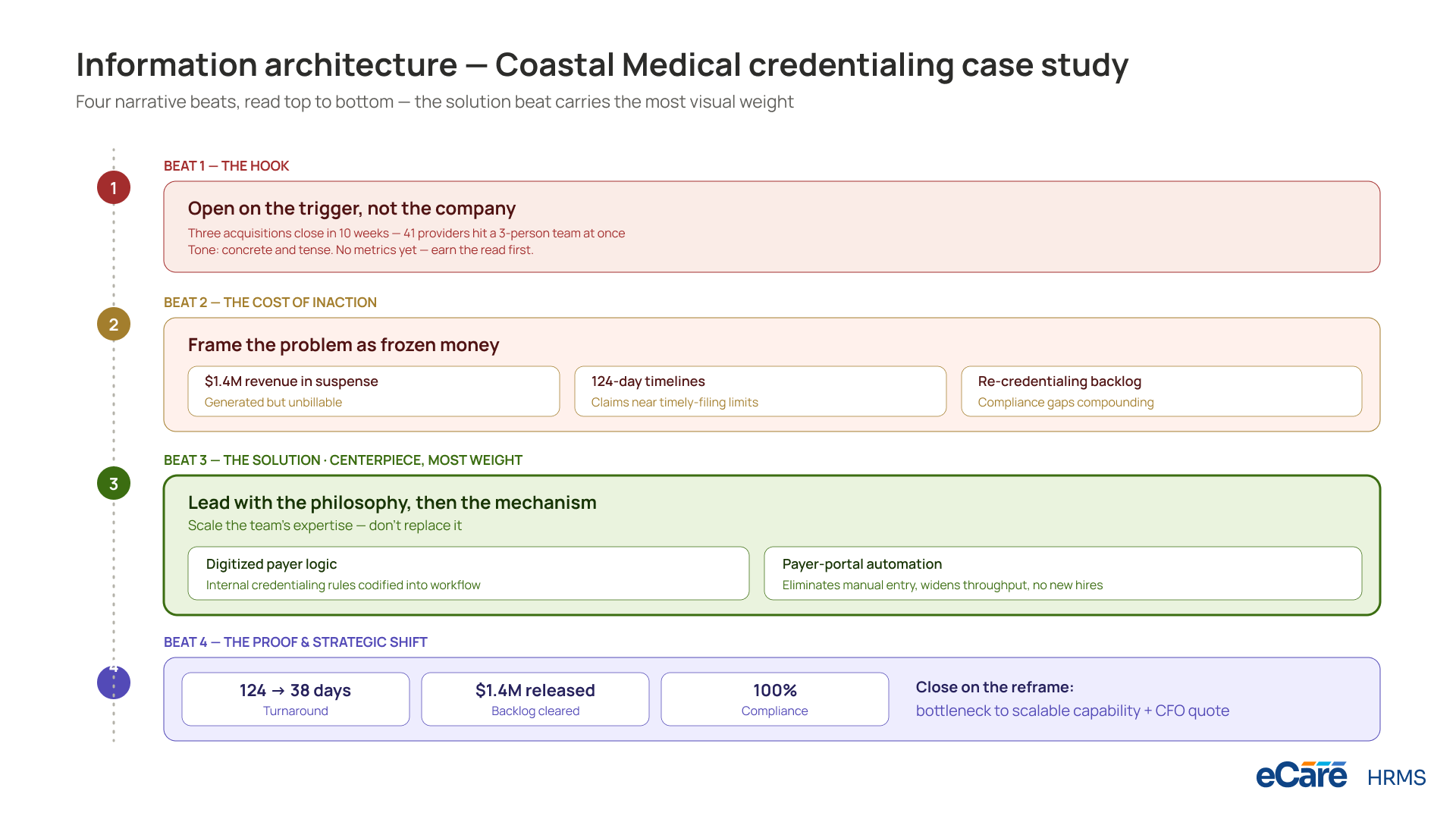
Coastal Medical Group experienced a rapid expansion in Q1 2025, completing three acquisitions within ten weeks. The acquisitions included a 14-physician primary care group, an 18-physician orthopedic group, and a 9-physician dermatology practice, adding 41 providers to the credentialing pipeline at once.
The central credentialing team of three FTEs was quickly overwhelmed. Each acquired practice followed different payer requirements and documentation standards, making the existing standardized credentialing workflow insufficient for the increased complexity.
Credentialing delays extended well beyond acceptable timelines, with providers waiting 60–120+ days for payer enrollment completion. During this period, generated revenue could not be billed, creating a significant backlog of unrecognized income.
At the 90-day mark, approximately $1.4M in provider-related revenue remained in suspense due to incomplete credentialing. Some claims were at risk of falling outside timely filing limits if delays continued.
The organization also faced compounding risks, as re-credentialing work for existing providers was deprioritized due to acquisition-driven workload.
- Three acquisitions added 41 providers to the credentialing pipeline simultaneously, exceeding team capacity.
- Credentialing timelines averaged 124 days, delaying billable status for new providers.
- $1.4M in revenue remained in suspense due to pending payer enrollment.
- Variation in payer and state requirements created workflow complexity across acquisitions.
- Re-credentialing backlog increased risk of claim holdbacks and compliance gaps.
Solution
The COO led the procurement in partnership with the credentialing manager, with a focus on scaling existing expertise rather than replacing it. The objective was to codify institutional knowledge and reduce manual workload without disrupting established workflows.
eCareHRMS was selected based on its ability to integrate payer-specific workflows and automate submission processes across multiple payer portals. The platform digitized existing credentialing logic developed by the internal team and embedded it into a structured workflow system.
A key capability was payer-portal automation, which eliminated manual data entry across multiple payer systems. This significantly reduced application processing time and increased throughput capacity for the credentialing team.
Value Delivered
Following deployment, credentialing timelines improved significantly and revenue backlog was cleared.
- Credentialing turnaround reduced from 124 days to 38 days for new providers.
- $1.4M in suspended revenue was successfully released and billed.
- Re-credentialing compliance reached 100% with no missed deadlines.
- Credentialing team throughput increased significantly without additional hires.
- Real-time visibility into credentialing pipelines replaced manual reporting processes.
Solution Provided
The deployment was executed in phased stages to prioritize backlog resolution before scaling across new acquisitions.
Weeks 1–3: The Most Stuck Providers
The initial phase focused on providers with the longest delays. Pending applications were processed and missing documentation issues were identified and resolved, enabling stalled cases to move forward in payer review cycles.
Weeks 3–6: Configuration Against Hattie’s Workflow
The platform was configured based on existing internal credentialing practices. Established rules and payer-specific knowledge were digitized to reduce manual handling and improve consistency across submissions.
Weeks 6–9: New-Acquisition Pipeline (27 Remaining Providers)
Newly acquired providers were processed through the optimized workflow, with automation reducing administrative burden and allowing staff to focus on validation and oversight.
Weeks 9–12: Re-Credentialing Catch-Up
The system identified upcoming re-credentialing deadlines and enabled structured processing of pending renewals, eliminating risk of compliance lapses.
Weeks 12–14: Real-Time Reporting and Operational Handover
A real-time credentialing dashboard replaced manual reporting, providing finance and operations teams with continuous visibility into provider status and revenue impact.
Business Value
The COO presented results to the executive committee in early 2026, highlighting credentialing as a scalable operational capability rather than a bottleneck.
What changed about acquisition capacity
Credentialing is no longer a limiting factor in acquisition strategy. The organization was able to continue expanding without experiencing post-close delays in provider onboarding.
The financial picture
The organization recovered $1.4M in previously suspended revenue and improved cash flow timing. Additional efficiency gains reduced the need for planned credentialing hires, resulting in further cost avoidance. Total annual impact was approximately $2.4M.
What changed about the credentialing function
Credentialing transitioned from a manual administrative function to a structured operational system supported by automation. Internal expertise was preserved and embedded into workflows, enabling scalable processing of provider onboarding and renewals.
The CFO’s note to the board
“Credentialing was no longer the constraint in our acquisition strategy. The ability to onboard providers faster has shifted growth planning from operational limitation to strategic execution.”